
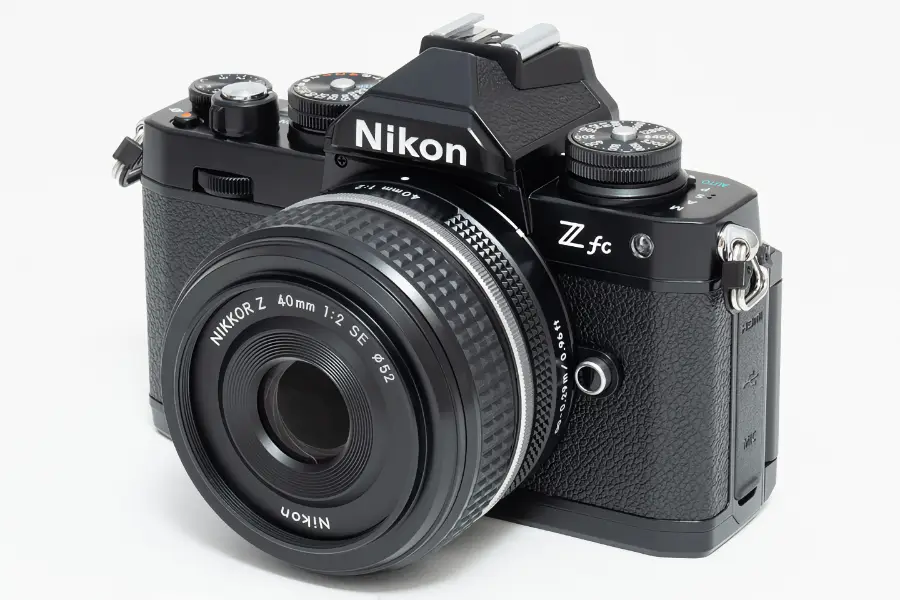
The Nikon Zfc is an APS-C mirrorless camera that combines retro design with modern technology. In this review, we’ll examine the Zfc’s key features, performance, and real-world usage experience in detail.
📊 Nikon Zfc Key Specifications

| Specification | Details |
|---|---|
| Sensor | 20.9MP APS-C CMOS (23.5 x 15.7mm) No low-pass filter |
| Processor | EXPEED 6 |
| Resolution | - Maximum: 5568 x 3712 - RAW: 12/14-bit - JPEG: Fine/Normal/Basic |
| ISO Range | Native: 100-51,200 Extended: 204,800 |
| Continuous Shooting | - Maximum 11fps - Electronic shutter: 11fps - Mechanical shutter: 11fps - Buffer: 35 RAW frames |
| Autofocus | - 209-point phase-detection AF - 90% image area coverage - Eye/Face detection AF - Animal detection AF |
| Video | - 4K UHD 30p/25p/24p - 1080p 120/100/60/50/30/25/24p - Time-lapse - Maximum 29 minutes 59 seconds |
| Viewfinder | - 2.36M-dot OLED EVF - 1.02x magnification - 60Hz refresh rate |
| Monitor | - 3.0-inch 1.04M-dot LCD - Fully articulating touchscreen - Selfie support |
| Storage | SD/SDHC/SDXC (UHS-I) |
| Connectivity | - USB Type-C (USB 3.2) - HDMI Type D - Wi-Fi 802.11ac - Bluetooth 4.2 - SnapBridge |
| Battery | - EN-EL25 lithium-ion battery - Approximately 300 shots (CIPA) - USB-C charging support |
| Body | - Aluminum alloy - Retro design - Front dial control |
| Dimensions | 134.5 x 93.5 x 43.5 mm |
| Weight | 390g (including battery/memory) |
🎨 Harmony of Retro Design and Modern Features
The most distinctive feature of the Nikon Zfc is its appearance. The classic design, reminiscent of the 1970s Nikon FM camera, evokes nostalgia among photography enthusiasts.
Classic Exterior

The Zfc’s body features a premium silver metallic finish that exudes quality. The dials positioned on the top provide a film camera-like shooting experience.
Modern Features

In contrast to its classic exterior, the Zfc’s interior is packed with the latest technology. It includes all the features expected in a modern camera, including a 20.9MP APS-C sensor, 4K video recording capabilities, and a touchscreen LCD.
Ergonomic Design

Despite its retro design, the Zfc hasn’t compromised on modern usability. The grip fits comfortably in hand, and the button and dial layout has been designed for easy operation.
📸 Image Quality and Performance
The Nikon Zfc boasts exceptional image quality. The 20.9MP APS-C sensor captures detailed images, while Nikon’s image processing technology delivers vibrant colors.
Low Light Performance

In low-light testing, clean images were achievable from ISO 100 to 1600 with minimal noise. While noise begins to appear from ISO 3200, images remain usable up to ISO 6400.
RAW File Flexibility

RAW files offer impressive editing potential. Testing showed that underexposed images could be recovered up to 5 stops without significant noise, providing great flexibility in post-processing.
Continuous Shooting Performance
The Nikon Zfc offers continuous shooting at up to 11fps. This speed is sufficient for most scenarios, particularly useful when capturing moving subjects.
🎥 Video Recording Capabilities

The Nikon Zfc demonstrates excellent performance not only in photography but also in video recording.
4K Video
The Zfc can record 4K/30p video. The 4K footage is sharp and capable of detailed expression.
Slow Motion Capability
1080p recording at 120fps enables impressive slow-motion video creation. The quality of 120fps footage matches that of standard 1080p, offering high usability.
Video AF Performance
Autofocus during video recording is smooth and accurate. The face/eye detection AF feature is particularly useful for portrait shooting, and subject tracking performance is excellent.
🔍 Autofocus System

The Nikon Zfc’s autofocus system demonstrates excellent performance in both accuracy and speed.
Face/Eye Detection AF

The AF system for recognizing human and animal faces and eyes is fast and accurate. It reliably tracks the main subject even with multiple faces in the frame.
Static Subject AF Performance
AF performance for static subjects is exceptional. It achieves focus quickly and accurately in most situations.
Low Light AF Performance
In typical lighting conditions, the Zfc’s AF performance remains stable. While AF speed and accuracy may slightly decrease in very dark environments, it maintains usable performance.
🖥️ Screen and Viewfinder
The Nikon Zfc provides a high-quality LCD screen and electronic viewfinder (EVF).
Tilt LCD Screen

The 3-inch 1040k-dot tilt LCD screen supports touch operation. The tilt functionality proves useful for low-angle or high-angle shooting.
Electronic Viewfinder

The EVF is sharp with quick response times. Its automatic brightness adjustment feature allows comfortable use in various environments.
Screen Display Options

Various information can be displayed on screen during shooting. Features like the level gauge and histogram enable more precise composition.
🎛️ Operation and User Interface
The Nikon Zfc’s control system offers both classic camera aesthetics and modern convenience.
Dial-Based Control System

The dials positioned on top allow direct control of ISO, shutter speed, exposure compensation, and more. This enables quick and intuitive adjustment of shooting settings.
Customizable Buttons

Multiple customizable buttons allow quick access to frequently used functions based on personal preferences.
Touchscreen Interface
The LCD’s touch functionality enables menu navigation, focus point selection, and shutter release, adding convenience to operation.
📱 Connectivity and Sharing Features
The Nikon Zfc offers modern connectivity and sharing capabilities.
Wireless Connection
Built-in Wi-Fi and Bluetooth enable connection to smartphones or tablets. The Nikon SnapBridge app allows remote shooting, image transfer, and location data addition.
Automatic Image Transfer
Through the SnapBridge app, images under 2MB can be automatically transferred to smartphones, convenient for quick social media sharing.
USB-C Connection

The USB-C port enables fast data transfer, external power supply, and battery charging.
🔋 Battery Life and Power Management

The Nikon Zfc uses an EN-EL25 lithium-ion battery. Battery life is sufficient for typical usage scenarios.
Power Efficiency
The Zfc features an efficient power management system. It automatically switches to power-saving mode when not in use to conserve battery life.
USB Charging
The ability to charge via USB-C port adds convenience. External power banks can be used for charging outdoors.
Power Display
Battery level is displayed with a three-stage icon. While the lack of precise percentage display is a minor drawback, it provides adequate information for most situations.
📷 Lens Compatibility and Recommended Lenses
The Nikon Zfc natively supports Z-mount lenses and can use F-mount lenses via the FTZ adapter.
NIKKOR Z 16-50mm f/3.5-6.3 VR

This is an excellent kit lens choice for the Zfc. It offers compact size, superior image quality, and VR (Vibration Reduction) functionality.
NIKKOR Z DX 50-250mm f/4.5-6.3 VR

Ideal for telephoto shooting, this lens pairs well with the Zfc. Its VR feature enables steady telephoto shooting.
NIKKOR Z 28mm f/2.8 (SE)

This special edition lens complements the Zfc’s retro design perfectly. Its compact size and bright aperture make it suitable for everyday photography.
🏞️ Real-World Experience and Sample Images
After using the Nikon Zfc in various environments, we gained a deeper understanding of its performance and usability.
Night Photography

Low-light performance is impressive. Usable images can be obtained up to ISO 6400, and thanks to the kit lens’s VR function, shake-free photos are possible even at slow shutter speeds of 1/8 second.
Landscape Photography

The Zfc’s color reproduction particularly shines in landscape photography. Its vibrant color rendition and wide dynamic range excel at capturing dramatic skies and landscapes.
Street Photography

The compact size and classic design are ideal for street photography. It remains unobtrusive while offering quick AF performance to capture decisive moments.
🆚 Comparison with Competitors
The Nikon Zfc’s main competitors include the Fujifilm X-T30 II, Sony A6400, and Canon EOS M50 Mark II.
| Specification | Nikon Zfc | Fujifilm X-T30 II | Olympus E-M10 IV | Canon EOS M50 II |
|---|---|---|---|---|
| Sensor | 20.9MP APS-C CMOS | 26.1MP APS-C X-Trans | 20.3MP M4/3 Live MOS | 24.1MP APS-C CMOS |
| Processor | EXPEED 6 | X-Processor 4 | TruePic VIII | DIGIC 8 |
| ISO Range | 100-51,200 (Exp: 204,800) | 160-12,800 (Exp: 51,200) | 200-25,600 (Exp: 100-25,600) | 100-25,600 (Exp: 51,200) |
| Continuous Shooting | 11fps | 8fps | 8.7fps | 10fps |
| AF System | 209-point Phase-detect AF | 425-point Hybrid AF | 121-point Contrast AF | 143-point Dual Pixel AF |
| Video | 4K 30p 1080/120p | 4K 30p 1080/120p | 4K 30p 1080/60p | 4K 24p 1080/60p |
| EVF | 2.36M dots 1.02x | 2.36M dots 0.93x | 2.36M dots 1.23x | 2.36M dots 0.95x |
| LCD | 3.0" Full-tilt 1.04M dots | 3.0" Tilt 1.04M dots | 3.0" Tilt 1.04M dots | 3.0" Vari-angle 1.04M dots |
| Stabilization | Lens VR | Lens OIS | 5-axis IBIS | Lens IS |
| Battery Life | 300 shots | 380 shots | 360 shots | 305 shots |
| Dimensions (mm) | 134.5 x 93.5 x 43.5 | 118 x 83 x 47 | 122 x 84 x 49 | 116 x 88 x 59 |
| Weight | 390g | 383g | 383g | 387g |
| Launch Price | $959 | $899 | $699 | $699 |
| Key Features | - Retro design - Dial controls - Full-tilt LCD | - Film simulation - Superior color - Compact size | - Built-in IS - Light weight - Low price | - Strong AF - YouTube live - Vertical shooting |
Comparison with Fujifilm X-T30 II

- Sensor: Both use APS-C sensors (Fuji 26MP, Nikon 20.9MP)
- Design: Both adopt retro design, but Fuji offers more dials
- Video: Both support 4K/30p, Fuji offers F-Log
- AF Performance: Both provide similarly excellent AF capabilities
Comparison with Sony A6400

- Sensor: Sony 24MP vs Nikon 20.9MP APS-C
- AF System: Sony’s Real-time Eye AF offers superior performance
- Design: Nikon’s retro design vs Sony’s modern approach
- Battery Life: Sony provides longer battery life
Comparison with Canon EOS M50 Mark II

- Sensor: Canon 24MP vs Nikon 20.9MP APS-C
- Video: Nikon offers uncropped 4K, Canon has significant crop in 4K
- EVF: Canon’s EVF provides higher resolution
- Lens System: Nikon Z-mount offers more lens choices
🌟 Pros and Cons Summary

Advantages
- Attractive retro design
- Intuitive dial-based control system
- Excellent image quality
- Compact size and light weight
- 4K video support
- Useful tilt LCD screen
- Reliable AF performance
Disadvantages
- No built-in flash
- Lower sensor resolution compared to some competitors
- Lack of battery percentage display
- No dual SD card slots
🎓 Conclusion

The Nikon Zfc perfectly harmonizes classic design with modern functionality. It’s an attractive choice for both photography enthusiasts who prefer retro design and users seeking a compact mirrorless camera.
It demonstrates excellent performance in crucial areas like image quality, AF performance, and operability, with the 16-50mm kit lens combination particularly well-balanced in terms of portability and image quality. The 4K video capabilities are also suitable for modern content creation.
However, there’s room for improvement in areas such as the lack of built-in flash, lower sensor resolution compared to some competitors, and limited battery level display.

Overall, the Nikon Zfc is highly recommended for users seeking both retro aesthetics and modern features. It’s particularly suitable for daily snapshots, travel photography, and vlogging.
Check out the Nikon Zfc in detail on the Nikon official website
We hope this review helps those considering the Nikon Zfc. Since camera choice depends on individual shooting style and needs, we recommend trying it hands-on if possible. Happy shooting!